
Everything I Learned About Physics, Geometry, and Dangerous Self-Assurance from My Living Room Window
What My New Neighbors Taught Me About Overconfidence and Ice Storms
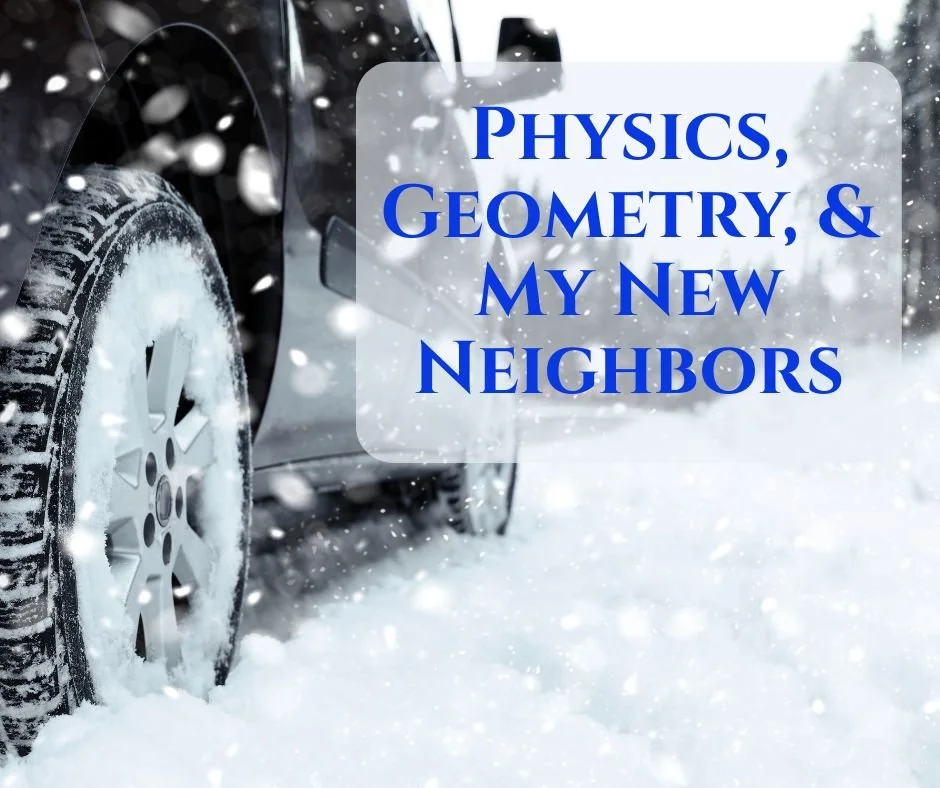
When I bought the former model home on the corner of the subdivision, the real estate listing emphasized the “large windows,” which came with premium pricing. What I didn’t realize was that I’d purchased front-row tickets to the theater of human optimism versus the laws of nature. The recent snow-and-ice storm that left our streets coated in what the weatherman described as “snowcrete” transformed my living room into an observation deck for a course in questionable decision-making.
Physics
The roundabout at the end of our street became a testing ground for several important physics principles, none of which my neighbors seemed to remember from high school.
Friction (or the lack thereof): Watching car after car enter the roundabout with what I can only describe as unearned confidence, I was reminded that ice does not care about your schedule. Wheels spun. Engines revved. The laws of physics remained unimpressed. The effort some drivers put into accelerating while going absolutely nowhere was Olympic-level. If “Roundabout Wheel Spinning” were an event, several of my neighbors would be medal contenders. Each one eventually required the crowd-sourced solution of being physically pushed out by other humans, which seemed to come as a surprise every single time.
Force and momentum: One particular neighbor pioneered what I’m calling the “Dangling Foot Propulsion System.” She drove with her driver’s door open, one hand gripping the door frame, the other on the wheel, and her left foot extended between the door and car like a child on a tricycle using their foot to push off when stuck. The physics of this approach remains unclear to me. Was she planning to Fred Flintstone her way down the street? Apply strategic foot-based course corrections? The execution raised more questions than it answered.
GEOMETRY
The relationship between visibility and navigation proved to be a recurring theme, particularly for one driver who presented a fascinating case study in angular perception.
Angles of vision: This gentleman had apparently decided that clearing his windshield, which was covered in several inches of snow and ice, was optional. Instead, he chose to navigate our street using only his driver’s side window, craning his neck at what must have been an uncomfortable angle to peer forward and slightly right. The problem with this geometric approach became immediately apparent: when you can only see what’s directly beside and slightly ahead of you on the left, you have absolutely no data about what’s happening on your passenger side.
Spatial relationships: His passenger-side tire met the curb with the inevitability of a geometry proof. The conclusion was foregone; only the timing was in question. I watched him slip and slide down the street in what appeared to be slow motion, his older car lacking any camera-view technology that might have compensated for his creative interpretation of “necessary visibility.” The curb won. The curb always wins when you can’t see the curb.
The roundabout radius problem: Multiple neighbors seemed unable to grasp that the turning radius required to navigate a roundabout successfully increases exponentially when the road surface has the friction coefficient of an ice rink. The number of vehicles that entered at what seemed like a reasonable angle, only to discover they were now pointed in an entirely different direction than intended, suggested a collective miscalculation of basic geometric principles. Six visible failed attempts did not deter the seventh driver. Optimism definitely overrides observational learning.
DANGEROUS SELF-ASSURANCE
If physics is what governs the world and geometry describes it, dangerous self-assurance is what makes people believe neither applies to them personally.
“I don’t need to clear my windshield”: This belief system, demonstrated by my side-window-navigating neighbor, rests on the assumption that partial information is sufficient for full decision-making. It is not. The curb he hit would like to submit a rebuttal.
“I can definitely make it through the roundabout”: Despite visible evidence of multiple failures—cars stuck at various angles, neighbors forming human pushing brigades, the general air of defeat hovering over the circle—each new driver approached with fresh conviction. “Those other people didn’t have my skills/tires/determination,” their body language suggested. The roundabout collected them all with the impartiality of gravity.
“A snow shovel will work on snowcrete.”: This was perhaps the most widespread miscalculation. Everyone I know who deployed a traditional snow shovel against the concrete-snow hybrid covering our driveways broke their shovels. Snapped handles. Cracked blades. The shocking realization that equipment designed for fluffy precipitation is useless against frozen cement wearing a disguise.
Tool improvisation as survival: Once the stores sold out of ice picks, axes, and steel-blade scrapers, the neighborhood got creative. I witnessed garden hoes, putty knives, and what appeared to be a fireplace poker deployed against the ice. My own contribution to the improvised tool catalog: a Pampered Chef lasagna spatula with a 5-inch, beveled-edge stainless-steel blade.
This turned out to be inspired problem-solving rather than dangerous self-assurance, and that’s a crucial distinction. The spatula’s edge was strong enough to wedge under sections of deck ice, lifting them just enough to let them drop and fracture. Then I could remove actual chunks rather than scraping futilely at an impenetrable surface. Sometimes self-assurance is dangerous. Sometimes it’s just recognizing that your kitchen drawer contains better engineering than the hardware store’s sold-out winter section.
WHAT THE WINDOWS HAVE TAUGHT ME
The model home’s large windows were designed to showcase the neighborhood’s appeal. What they’ve really shown me is that my neighbors are consistently, creatively optimistic in the face of physical laws that do not negotiate. They will try things. They will fail spectacularly.
I’ve been told (by the two neighbors I’d met in person before we all got iced in) that many people on our street work in the medical field. Nurses. Doctors. People entrusted with human lives and complex decision-making under pressure. I’m choosing to believe, for my own peace of mind, that none of the medical professionals were the ones I observed during my viewing experience. The windshield-snow navigator? Definitely works in IT. The door dangling foot dragger? Probably an accountant. The roundabout repeat attempters? Middle management, all of them.
But here’s what else the windows showed me: after each roundabout failure, multiple neighbors materialized to push. Without being asked. In below-freezing temperatures. On ice. People carved out spots in our community specifically so the dogs would have somewhere to do their business. Shovels and ice picks were loaned freely once the stores sold out. The Pampered Chef spatula strategy was mine alone, but the willingness to help was universal.
My former neighbors couldn’t manage to wave hello. In my new community, they form human pushing brigades in a snowstorm for people they’ve never met. Yes, they make bad choices about visibility and friction, but they show up for each other while making them.
Before I get too comfortable in my role as bemused observer of other people’s physics failures, I should mention that I just spent forty-five minutes searching for an earring. I found one on my stairway, which confirmed my theory that I’d lost the other somewhere in the house. I tore through rooms. I retraced my steps. I checked coat pockets. I was utterly certain about the facts. I was missing an earring, and I needed to find it.
Guess what? It was in my ear. Where it was supposed to be. Where it had been the entire time.
Dangerous self-assurance, it turns out, is not limited to winter driving decisions.
I think I’m going to like it here.
What unexpected lesson have your neighbors taught you? Share your story in the comments. I'd love to hear about the people who make your community memorable.
Keeping it real and creatively visible,
🍫 Meagan


Father's Day isn't simple for everyone. This is a survival guide — funny, a little defiant, and honest about what the holiday actually feels like when your father isn't who he should have been.